
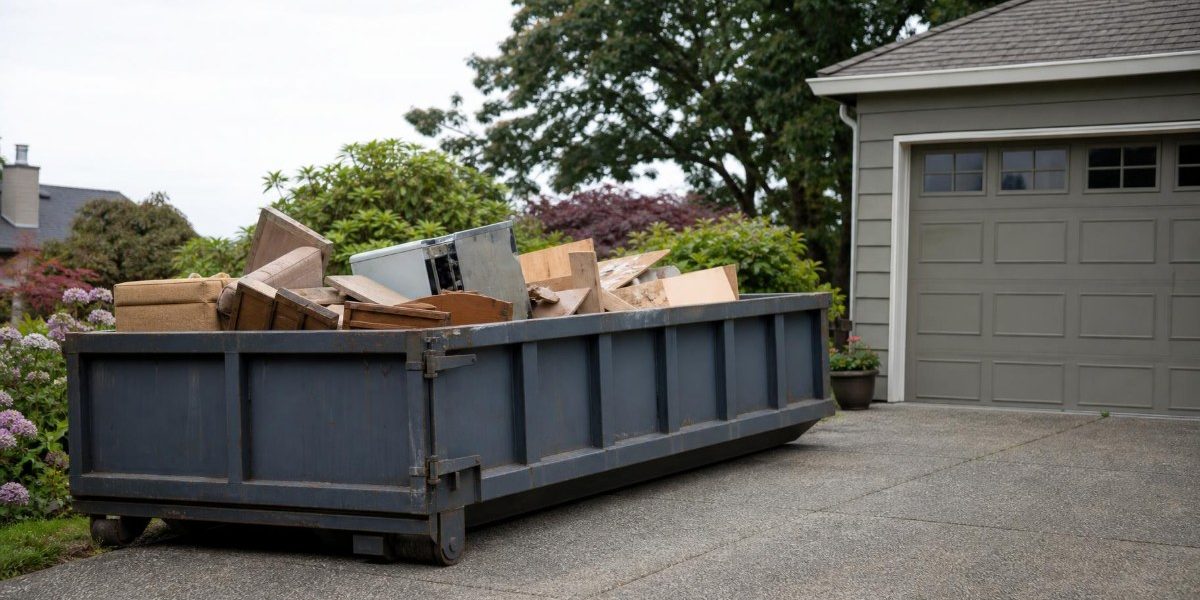
Most household clean-out items, renovation and construction debris, metals and appliances can go in a rental bin in Victoria, BC. Hazardous materials, liquids and asbestos cannot. Two local rules shape the details. Building materials older than 1990 need asbestos testing paperwork, and some materials have to go in separate bins so they can be sorted properly. If you are working out what you can put in a bin rental before a clean-out or a renovation, this post covers what goes in, what stays out, and where the things that stay out can go instead.
What You Can Put in a Rental Bin
Our roll-off bin rentals accept a long list of materials, and we group them here by the kind of job they come from. If you have been wondering what you can put in a dumpster for a Victoria project, most everyday waste is on this list.
Household and clean-out items
Basement, garage, estate and yard clean-ups fill most of our smaller bins. Furniture, toilets, pane glass, cardboard, clothes hangers, and extension and appliance cords all go in, along with general household items from basement, estate and yard clean-ups. Christmas trees are on the list too, which helps every January.
Renovation, construction and demolition waste
Renovation and construction jobs produce the widest mix of material. Our bins take construction, renovation and demolition waste, drywall and gypsum board, roofing materials and asphalt shingles, wood shakes, lumber, wood and composite pallets, concrete, road asphalt, and flood and fire restoration waste.
Several of these carry an asterisk on our list. Drywall, gypsum board, roofing materials, asphalt shingles, and construction, renovation, demolition and flood and fire restoration waste "will or may" need hazardous waste testing. A later section explains how that testing works in Victoria.
Metals and appliances
Aluminum, brass, bronze, copper, steel and other metals go in, along with large appliances, dryers and hot water tanks. Metals are often repurposed after they leave our site, so a bin of scrap from a garage or a plumbing upgrade has a second life.
Yard clean-ups
Yard clean-ups are a regular job for our mini bins, and household items from yard clean-ups are on the accepted list. Soil, sand and sod stay off the list, and our recycling depot page names them as items we cannot take.
Things Many Bin Companies Refuse That H.L. Disposal Takes
Many rental bin guides list electronics, fridges and freezers, tires and car batteries as banned. Our list says something different. It names computers, computer monitors, televisions, stereos, freezers and refrigerators, automotive tires and automotive batteries, along with large appliances and dryers.
That helps anyone with a garage full of old electronics or a dead fridge in the basement. Those items can ride in the same clean-out bin as the furniture and boxes, so one bin can carry the whole job. Mixed loads go to our sorting facility, where staff separate recyclable material from what cannot be recycled.
One condition comes with the list. Some accepted items cannot go together in the same bin. A heavy load of concrete and a bin of household clutter often need to be planned as two separate bins, for example. Our office team helps plan the bins for each job and works to keep the cost down, so tell our office team what you have when you book.
What Is Not Allowed in a Rental Bin
Our list of what is not allowed in a roll off dumpster is short and specific. These items cannot go in our bins:
- Asbestos or materials containing asbestos
- Paints, pesticides and liquids, in open or sealed containers
- Toxic waste and dangerous goods
- Household hazardous waste
- Vehicle fluids such as motor oil and antifreeze
- Animal waste, including carcasses and pet excrement
- Biomedical, radioactive and reactive waste
- PCB waste
- Mercury
- Food waste
These materials stay out because of what they can do. Liquids leak, some chemicals catch fire, and a spilled container can contaminate a whole load of recyclable material. Drivers and sorting staff handle every bin, and they need loads that are safe to lift, haul and sort. Hot ashes and smouldering material belong on this list as well, since the regional landfill bans waste that is on fire or smouldering. Batteries show the danger well, because lithium-ion batteries caused more than 240 fires at 64 waste management facilities between 2013 and 2020.
Each of these items has a proper place to go in the capital region. Residents can drop off household hazardous waste at the Hartland Public Drop-off Depot at no charge. The depot takes latex, oil-based and spray paint, paint thinner and solvents, pesticides and herbicides, aerosols, and pool and hot tub chemicals, in household quantities from residential sources. Our own recycling depot at 334 Hillside Avenue takes refillable propane tanks, which are not on the bin list.
Batteries follow the same split. Our bin list names only automotive batteries, so household batteries and e-bike or e-scooter batteries go to the Hartland depot, which accepts them at no charge.
Renovation Waste, Drywall and the Pre-1990 Asbestos Rule
This rule catches out more Victoria renovators than any other. Asbestos was used in building materials up until 1990, and an estimated 3,000 types of building materials from that period contain it.
Our recycling depot page says all building material waste older than 1990 must be tested for asbestos. It is accepted only with documents showing it tested free of asbestos. Drywall, asphalt roofing, plaster, stucco and vinyl flooring are some of the products that need testing, and there are many more. Environmental labs in Victoria do the sample testing. Material that does contain asbestos does not go in the bin at all. Homeowners can take it to Hartland in their own vehicle by appointment, with lab results, double-bagged in labelled 6 mil poly asbestos bags and under 1,000 kg in any 30-day period.
The region asks for the same proof. Before any renovation or demolition work, a qualified person must carry out a hazardous materials survey to find potential hazardous materials on site. Hartland takes clean renovation waste only with laboratory test results or proof the materials were installed after 1990, and lab results must be no older than one year.
Drywall gets the most attention in the capital region for a reason. When Hartland ran a recycling bin for clean drywall, random samples tested positive for asbestos more than 70 percent of the time, and the bin was removed. Drywall and gypsum board sit on our bin list with an asterisk for that reason. Getting a sample tested before the bin arrives keeps the project moving.
Heavy Materials and Bin Weight Limits
Concrete, road asphalt and roofing materials are all accepted, and all of them are heavy. A bin has two limits, its volume and its weight, and heavy materials reach the weight limit first. Our mini bins hold up to 3 tons. Our 20, 30 and 40 yard bins hold up to 10 tons.
A bin of concrete can look half empty and already be at its limit. A few loads of broken slab or a roof's worth of asphalt shingles use up tons of capacity while barely filling the box. Lighter clean-out waste such as furniture and cardboard fills a bin the other way around, with plenty of weight to spare and no room left.
Heavy debris often does better in its own bin, apart from the lighter material. That fits the point on our list that some items cannot go together in the same bin. A bin of concrete can be filled to its weight limit, and a second bin of lighter waste can be filled to the top. Each bin then works to its strength, and the pair usually costs less than a single bin that mixes the two.
Mixed Loads or Sorted Loads: How Sorting Works in the Capital Region
Our bins accept mixed loads. A mixed bin goes to our sorting facility, where staff separate recyclable material from what cannot be recycled. We work to divert as much material as we can from the end-of-life waste stream.
Sorting matters so much here because the regional landfill bans many materials from general garbage, including clean wood, treated wood, asphalt shingles, cardboard, scrap metal, and yard and garden waste. Hartland also charges a different rate for each stream, as listed in its rates by material: $160 per tonne for general refuse, $155 for clean renovation and demolition waste, $110 for asphalt shingles and treated wood, and $80 for clean wood. Clean wood, treated wood and asphalt shingles must arrive separated from garbage and renovation waste, and fines apply if they arrive mixed.
Loads are inspected on arrival. A load with excessive recyclable or compostable material can be ticketed under CRD bylaw on top of the disposal cost, and the hauler may be asked to take the material away. Roughly 47 percent of the material received at Hartland could have been diverted through existing recycling programs, which explains the close attention.
A rejected load costs time and money, so the best moment to handle it is the booking. When you list the materials going in as you book, our office team can plan which items share a bin and which go in a bin of their own.
Not Sure About an Item?
Our Bin Rental Form asks for the type of materials when you book, and our office team matches the bin to the job. You can request a quote on our bin rentals page or send a question through our Contact page before you load anything you are unsure about.
